Performance review accomplishments: examples for engineers
Most self-reviews read like a changelog: shipped this, fixed that, attended the other. Reviewers can't tell what any of it changed. Here is a simple way to turn what you did into accomplishments that hold up, with weak and strong examples for the kinds of work engineers actually do.
A task is not an accomplishment
"Worked on the payments migration" describes your calendar. An accomplishment answers the question your manager and the calibration room will ask: so what? Who is better off, what is faster or safer, what decision went differently because you were there?
That gap is widest for the work that never shows up in a ticket: the design review where you changed the plan, the afternoon you spent unblocking another team, the risk you raised before it became an incident. If you don't write those down with their outcome, nobody else will.
The formula: action, outcome, evidence
Every accomplishment needs three parts. The order matters less than having all three, but leading with the outcome makes it easier to skim.
- Action: what you specifically did. "I", not "we", where it was you.
- Outcome: what changed. Time saved, risk removed, a team unblocked, a decision made, a person who grew.
- Evidence: something a reader can check: a link to the PR or design doc, a number, a date, a quote from a stakeholder.
If you know the STAR method (situation, task, action, result) from interviews, this is the same idea compressed for a review form, where the situation is usually obvious to the reader.
Weak vs strong examples
The examples below are illustrative, not real. Swap in your own systems, people and numbers; never borrow figures you can't back up.
Delivery
Weak:   Worked on the checkout redesign.
Strong: Led the backend for the checkout redesign and shipped it
        behind a flag two weeks before the holiday freeze, so the
        team had time to roll back if needed (launch doc, PR list).
Unblocking others
Weak:   Helped the mobile team with an API issue.
Strong: Found the pagination bug that had blocked the mobile
        team's release for three days, paired with their engineer
        on the fix and added a contract test so it can't regress
        (PR, release notes).
Influence on technical decisions
Weak:   Gave feedback on the caching design.
Strong: My review of the caching design pointed out that it
        cached per-user data at the CDN. The team switched to
        per-service caching before launch (design doc comments).
Mentoring
Weak:   Mentored a junior engineer.
Strong: Weekly pairing with a new hire through their first
        quarter; they now own the notifications service on-call
        rotation on their own (their manager's note in the
        quarterly review).
Risk spotted
Weak:   Noticed some issues with the certificate setup.
Strong: Flagged that our TLS certificates were renewed by hand
        and two expired in the same month; automated renewal and
        added an expiry alert (ticket, runbook).
Operations and incidents
Weak:   Was on call and handled incidents.
Strong: Incident commander for the March database failover;
        wrote the postmortem and drove 4 of its 5 follow-ups to
        done (postmortem link).
Notice what the strong versions share: a concrete action, a result someone else would care about, and a pointer to proof. None of them needs a dramatic number.
When you have no metrics
Much engineering impact is real but hard to put a percentage on. Don't invent one; a reviewer who asks "where does 40% come from?" and gets no answer will discount the rest. Use evidence you actually have:
- Scope: how many people, teams or services were affected.
- Before and after: "the release needed a manual step every week; now it doesn't."
- Time: days saved, a deadline met, a wait that disappeared.
- Decisions: what was decided differently because of your input.
- Recognition: a thank-you message, a shout-out in a demo, a peer's feedback. Quote it with the date.
- Things that didn't happen: an outage avoided because you caught a risk. Say what you saw and what you changed; let the reader draw the conclusion.
Finding the accomplishments you forgot
If you didn't keep notes, rebuild the period from the places that remember for you:
- Your calendar. Design reviews, incident calls and 1:1s with people outside your team point to influence and unblocking.
- Code review history. Reviews you gave, not only PRs you merged. Long threads usually mean you changed something.
- Chat and email. Search for "thanks", "thank you" and your name in other teams' channels.
- Docs. Design docs and postmortems you wrote or commented on.
- Tickets you closed or unblocked. Useful for delivery, weak for everything else.
This works, but it takes hours and still misses the hallway conversations. The lasting fix is to capture as you go, in a brag document: a short note at the time, with the outcome added later.
Turn the list into a self-review
- Open your company's career ladder or level expectations. Those are the themes your reviewers are scoring.
- Sort your accomplishments under those themes. Drop what doesn't fit any of them.
- For each theme keep the two or three examples with the strongest evidence.
- Write one or two sentences per theme that say what the examples add up to, then list the examples under it.
- If you use an AI assistant to tighten the wording, give it the specifics and rewrite the result in your own voice. Check your employer's policy before pasting internal details into an external tool.
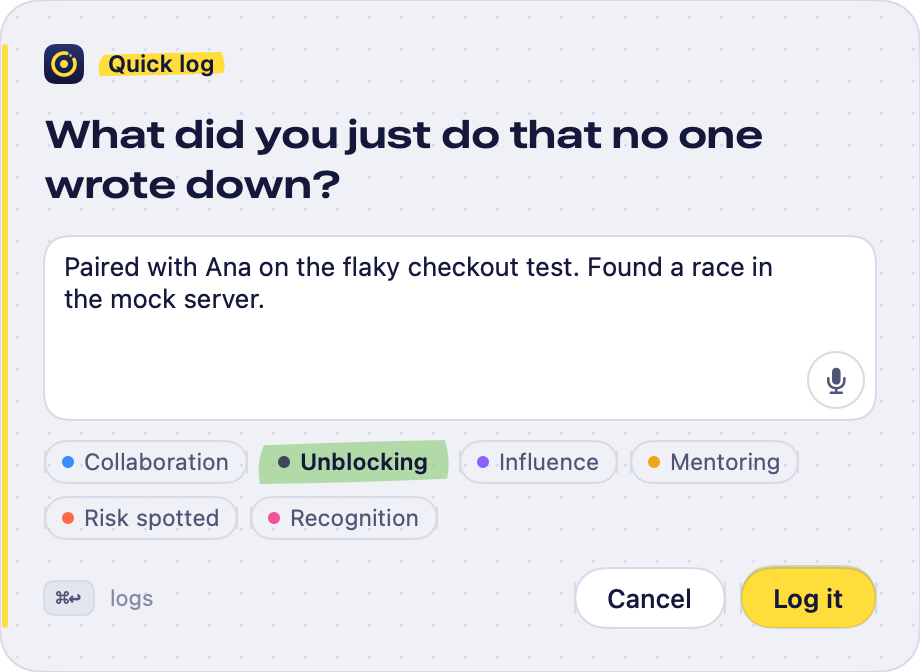
Impact Capture is a free, open source macOS menu bar app. It checks in when you come back to your Mac and at the end of the day, takes a typed or spoken sentence, lets you tag it (unblocking, influence, mentoring, risk spotted and more), and writes dated Markdown files to a folder you pick. Export the last 90 days or this half as one document when it's time to write. Nothing leaves your Mac.
brew install --cask frugoman/tap/impact-capture
See how it works · Download
FAQ
How do I write accomplishments for a performance review?
Write each one as what you did, what changed, and the evidence. Lead with the outcome and keep it to two or three sentences.
What if my accomplishments have no metrics?
Use scope, before and after, time saved, decisions changed or a stakeholder's words. A specific, checkable claim beats an invented number.
How many accomplishments should I list?
A few themes that match your role's expectations, each with two or three strong examples. Follow your company's template if it has one.
Related: How to keep a brag document engineers actually use.